Pricing

Markt POS vs. Square:
How do they compare for independent grocery stores?

If you're shopping for a market POS system, you've probably looked at Square. It's one of the most recognizable names in payments, with a free plan and a reputation for simplicity.

Markt POS is less familiar, but it was designed by multi-generational grocers for exactly the kind of store you run.

Here's what you need to know about their features, pricing, and what they actually look like inside a busy market.

Last updated: February 2026

Markt POS vs Clover

On the surface:
Square vs. Markt POS

Popular POS with easy setup and a free plan

Square

Square is a household name in payments. The free plan, sleek hardware, and fast setup make it appealing for anyone starting a small business. But Square was built as a general retail platform. It covers coffee shops, clothing stores, restaurants, and grocery stores. Scale integration, EBT/eWIC, self-checkout, and the kind of inventory management a market needs aren't part of the core experience.

Built for neighborhood markets, by grocers

Markt POS

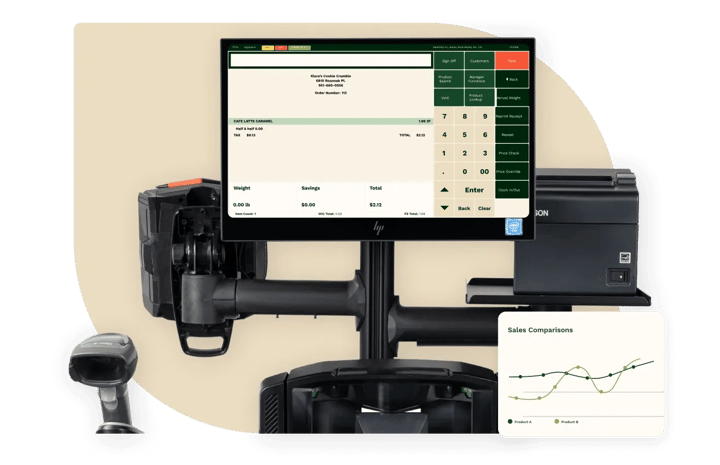
Markt POS was built for the stores that general-purpose systems overlook. The neighborhood market, the international grocer, the family butcher shop. Scale integration, EBT, custom label printing, and self-checkout come standard. No app marketplace required because the features market owners actually need are baked into the system.

Square: Pricing

Hardware

Square sells its own hardware lineup, from the handheld Square Reader ($49) to the standalone Square Register ($799–$899). Register kits that include a cash drawer, receipt printer, and paper rolls run approximately $1,339. You can use some third-party hardware with Square, but the ecosystem is optimized for Square's own devices.

Software

Square restructured its retail plans in late 2025. The free plan still exists with basic POS features. Third-party sources show varying prices ($49–$89/mo for the mid-tier plan). Add-ons increase the real cost: Loyalty starts at $45/month, Marketing runs $15–$195/month, and Payroll is $29/month plus $5/employee.

Payment processing

Square charges flat-rate processing: 2.6% + $0.15 per in-person tap, dip, or swipe; 2.9% + $0.30 for online transactions on the free plan.  Higher software tiers may offer slightly lower rates. No long-term contracts, which is a genuine advantage. But flat-rate pricing means high-volume stores pay the same percentage whether they're processing $10,000 or $100,000/month — interchange-plus pricing would likely save money at higher volumes.

Markt POS: Pricing

Hardware

Markt POS takes a different approach to hardware. The Starter plan is software-only, so stores with existing compatible equipment can keep what they have. Growth and Premium plans include bundled hardware — registers, scanners, and PIN pads — in the monthly cost rather than requiring upfront purchase. Peripherals like scanner scales, label-printing scales, and mobile inventory devices are available as add-ons. All bundled hardware is covered by a 2-year warranty.

Software

Markt POS offers three tiers starting at $49/mo with no long-term contracts and a 30-day money-back guarantee. Every plan includes 24/7 phone support and unlimited staff training — there's no per-seat charge for additional cashiers. Higher tiers unlock QSR modifiers for hot food counters, built-in loyalty, advanced inventory with expiration tracking, multi-store management, and integrated e-commerce.

Payment processing

Payment processing is included with every Markt POS plan — no separate merchant account required. The system accepts EMV chip, debit, EBT food and cash, gift cards, checks, and contactless payments, including Apple Pay and Google Pay. Store-and-forward technology keeps transactions flowing during internet outages, and instant payouts are available around the clock. Rates are custom-quoted based on volume.

One standout: Integrated roundup donations to Meals on Wheels America at the PIN pad.

What a market owner actually pays

Square's free plan is the hook, but it doesn't include the features a market depends on daily. Most grocery owners land on a paid plan quickly, and from there, the add-on costs start compounding:

  • Loyalty program: $45/mo
  • Marketing tools: $15–$195/mo
  • Payroll: $29/mo + $5/employee
  • EBT/eWIC acceptance: not available
  • Self-checkout: not available

The add-ons add up — but the bigger issue for market owners isn't the price. It's the features that don't exist on Square at any price point: EBT/eWIC, self-checkout, bottle deposit tracking, wholesaler integration, and shrinkage analysis by department.

Markt POS includes scales, EBT, eWIC, self-checkout, and 24/7 support, starting at $49/mo. Loyalty and e-commerce are available on the Growth plan and above.
Features:
Markt POS vs. Square

Get the full scoop on how Markt POS pricing, features, and support stack up against Square's offerings.

* Please contact us if this page contains inaccuracies or needs an update.

square logo
Markt POS
Features
Grocery self-checkout

Self-checkout lanes reduce labor costs and keep lines moving during peak hours.

No
Yes
Cloud-based system

Cloud-based software lets you access your store from anywhere, at any time.

Yes
Yes
No long-term contracts

Getting locked into a multi-year contract limits your flexibility and can cost you if the system isn't the right fit.

Yes
Yes
Free inventory import & setup

Migrating to a new POS means moving thousands of SKUs, configuring departments, and training staff. How much of that your new provider handles for you can make or break the switch.

No
Yes
EBT & eWIC

If you run a market, EBT and eWIC acceptance isn't optional. It's how a significant portion of your customers pay.

No
Yes
Low stock alerts

Automated alerts help you stay on top of inventory before shelves go empty.

Yes
Yes
Mobile POS

A mobile POS lets you ring up sales anywhere — from the aisle to the sidewalk to a farmers market booth.

Yes
No
Advanced reporting

In grocery retail, knowledge is power, and that's where your POS system's sales reports come in.

No
Yes
Product management

Markets sell items by weight, by unit, and by barcode across multiple departments. Product management tools organize and maintain that catalog, keeping it accurate.

Yes
Yes
Grocery e-commerce

E-commerce has the power to expand your customer base and boost your sales, but to sell online, you need a POS system with e-commerce integration.

Yes
Yes
App marketplace & integrations

A large integration ecosystem lets you connect your POS to the rest of your tech stack.

Yes
No
Dual pricing

Dual pricing is a strategy where businesses offer a lower price for customers who pay with cash, while the standard price remains for card payments.

No
Yes
Wholesaler integration

Direct connections to your suppliers keep pricing current and ordering simple.

No
Yes
Deli scale integration

Selling by weight is a daily reality in markets. Your POS needs to handle it natively.

Yes
Yes
Label printing

Accurate, professional labels keep your shelves organized and your pricing transparent.

Yes
Yes
Built-in customer loyalty

Built-in customer loyalty and promotion features can help you attract and retain valuable shoppers.

Yes
Yes
Age verification

Selling age-restricted products requires reliable ID checks at the register.

No
Yes
Shrinkage management

Inventory shrinkage costs markets thousands each year. The right tools help you catch it early.

Yes
Yes
Employee management

Managing staff schedules, permissions, and performance from your POS saves time and reduces errors.

Yes
Yes
QSR features

If your market offers hot or made-to-order food, you need quick-serve functionality built into your POS.

Yes
Yes
Bottle deposit tracking

If your state requires bottle deposits, your POS should handle them without workarounds.

No
Yes
square logo
Markt POS
Features
Grocery self-checkout

Self-checkout lanes reduce labor costs and keep lines moving during peak hours.

No
Yes
Cloud-based system

Cloud-based software lets you access your store from anywhere, at any time.

Yes
Yes
No long-term contracts

Getting locked into a multi-year contract limits your flexibility and can cost you if the system isn't the right fit.

Yes
Yes
Free inventory import & setup

Migrating to a new POS means moving thousands of SKUs, configuring departments, and training staff. How much of that your new provider handles for you can make or break the switch.

No
Yes
EBT & eWIC

If you run a market, EBT and eWIC acceptance isn't optional. It's how a significant portion of your customers pay.

No
Yes
Low stock alerts

Automated alerts help you stay on top of inventory before shelves go empty.

Yes
Yes
Mobile POS

A mobile POS lets you ring up sales anywhere — from the aisle to the sidewalk to a farmers market booth.

Yes
No
Advanced reporting

In grocery retail, knowledge is power, and that's where your POS system's sales reports come in.

No
Yes
Product management

Markets sell items by weight, by unit, and by barcode across multiple departments. Product management tools organize and maintain that catalog, keeping it accurate.

Yes
Yes
Grocery e-commerce

E-commerce has the power to expand your customer base and boost your sales, but to sell online, you need a POS system with e-commerce integration.

Yes
Yes
App marketplace & integrations

A large integration ecosystem lets you connect your POS to the rest of your tech stack.

Yes
No
Dual pricing

Dual pricing is a strategy where businesses offer a lower price for customers who pay with cash, while the standard price remains for card payments.

No
Yes
Wholesaler integration

Direct connections to your suppliers keep pricing current and ordering simple.

No
Yes
Deli scale integration

Selling by weight is a daily reality in markets. Your POS needs to handle it natively.

Yes
Yes
Label printing

Accurate, professional labels keep your shelves organized and your pricing transparent.

Yes
Yes
Built-in customer loyalty

Built-in customer loyalty and promotion features can help you attract and retain valuable shoppers.

Yes
Yes
Age verification

Selling age-restricted products requires reliable ID checks at the register.

No
Yes
Shrinkage management

Inventory shrinkage costs markets thousands each year. The right tools help you catch it early.

Yes
Yes
Employee management

Managing staff schedules, permissions, and performance from your POS saves time and reduces errors.

Yes
Yes
QSR features

If your market offers hot or made-to-order food, you need quick-serve functionality built into your POS.

Yes
Yes
Bottle deposit tracking

If your state requires bottle deposits, your POS should handle them without workarounds.

No
Yes

What do market owners say?

Hear from real store owners who use both systems.

Square

Square currently has a 4.7 rating on Capterra.

Square's reviews reflect its enormous user base — but that base is mostly restaurants, coffee shops, and general retailers. Grocery and specialty market reviews are rare in the mix.

Owners who use Square for market-type businesses tend to praise its simplicity, no-contract flexibility, and the speed of getting started. The recurring frustrations for market owners are predictable: no EBT support, limited grocery-specific inventory tools, and add-on costs that accumulate faster than expected.

The real strength Square users cite is the low barrier to entry. The real gap is everything that happens after you outgrow basic transactions.

Markt POS

Markt POS currently has a 5.0 rating on Google, based on 60 reviews.

Markt POS reviews come primarily from independent market owners — international grocers, butcher shops, and specialty food stores who switched from general-purpose systems. The grocery-specific feature set (scales, EBT, department-level inventory) and the hands-on support experience are the most frequently cited reasons for switching.

What comes up most: the system was clearly designed by people who've worked in markets. The most common trade-off owners mention: payment processing is bundled, so you can't shop for your own processor.

Markt POS vs. Clover Comparison

Clover logo
marketPOS-logo

Cloud-Based System

Yes
Yes

Integrated Payment Processing

Yes
Yes

Integrated EBT Support

No
Yes

Integrated Scanner Scales

No
Yes

Self-Checkout

No
Yes

Inventory Management
for Fresh Food

No
Yes

Dual Pricing

Yes
Yes

Unlimited SKUs

No
Yes

CSV Imports

Yes
Yes

Grocery E-Commerce

No
Yes

No Long-Term Contracts

No
Yes

Free Inventory Import & Setup

No
Yes

Dedicated Customer Success & Technical Support Representative

No
Yes

Free Training Resources

Yes
Yes

Onboarding & support

Switching POS systems is rarely simple, but the right onboarding and support make it easier on you, your staff, and customers.
PNG to WEBP Support

Square

Square's setup is designed for speed and simplicity. You can be processing payments within minutes of opening the box. But "up and running" for a coffee shop is a different bar than "up and running" for a market with produce, meat, deli, and dry goods departments that each need their own pricing rules, inventory categories, and margin profiles.

Support is available through phone, email, and chat, backed by a large knowledge base. Quality varies — and the support team is built for general retail, not grocery-specific troubleshooting. Free plan users get limited support hours (Monday–Friday, 6 AM – 6 PM PT). 24/7 support is only available on paid plans.

Inventory setup is entirely self-service. CSV imports and bulk uploads are available, but configuring departments, by-weight items, and product categories for a full market inventory is on you.

Markt POS

Markt POS handles onboarding hands-on. Our team helps import your inventory, configures departments, connects your scales, and trains your staff before you go live. Support is 24/7 by phone — handled in-house by people with grocery industry experience, not routed through resellers or general call centers.

This matters more than it sounds in practice. Setting up a system to handle produce by weight, deli items by count, and packaged goods by barcode — across departments with different margin targets and vendor relationships — is genuinely complex.

It's not something most owners want to figure out alone through a help article. Unlimited training is included on all plans, which pays off every time you hire a seasonal cashier or bring on someone who's never worked a scale at checkout.

Onsite hardware installation is available as a paid add-on. Video tutorials and training materials are also available for ongoing reference.

Markt POS Support (1)

Which POS system makes sense for your market?

Square and Markt POS are built for different types of stores, even if both can technically ring up groceries.

Square makes sense if you:

  • Want the lowest possible barrier to entry and a free plan to get started

  • Run a very small market or convenience store where EBT, eWIC, and by-weight pricing aren't critical

  • Prefer a well-known brand with broad name recognition and a large support ecosystem

  • Do most of your business in simple card transactions without grocery-specific needs

Markt POS makes sense if you:

  • Run a neighborhood market, international grocer, butcher shop, fish market, co-op, or specialty food store

  • Need EBT, eWIC, and by-weight pricing working reliably from day one — not bolted on through third-party apps

  • Want a system designed around perishable inventory, department-level reporting, and the operational rhythm of a market

  • Prefer hands-on onboarding, unlimited training, and 24/7 support from people who understand grocery

Square is a strong starting point for small businesses getting into retail. But grocery is a specialized industry. The features market owners rely on every day — EBT, eWIC, self-checkout, bottle deposits, shrinkage tracking, wholesaler integration — either don't exist on Square or require workarounds that weren't designed for the pace of a busy market.

Markt POS was built for exactly those challenges, by people who've lived them.


Want to see the difference?

Specs on a page only tell you so much — the real test is watching a POS handle your products, your departments, and the way your store actually runs on a busy Saturday morning.

Frequently asked questions

Does Square work for grocery stores and markets?

Square handles basic grocery transactions well — it's fast, reliable, and easy to set up. Where it falls short is the grocery-specific workflow layer. EBT/eWIC acceptance, self-checkout, bottle deposit tracking, and wholesaler connections aren't available.

Square does support scale-based selling, but the integration isn't as deeply integrated into grocery workflows as a purpose-built system.

Markt POS includes scale integration, EBT, label printing, and department-level inventory on every plan.


Does Square accept EBT and eWIC?

No. Square does not support EBT or eWIC payments. For most grocery stores, this is the single biggest limitation.

Markt POS includes EBT food and cash acceptance on all plans with no additional setup. eWIC is also supported for stores that serve WIC customers.

How much does Markt POS cost compared to Square?

Square's free plan covers basic transactions, but most markets need a paid plan for inventory management and reporting. Add-ons like Loyalty ($45/mo), Marketing ($15–$195/mo), and Payroll ($29/mo + $5/employee) increase the real monthly cost — and grocery-specific features like EBT and self-checkout aren't available at any price.

Markt POS starts at $49/month (software-only), with hardware bundles included on Growth and Premium plans. No long-term contracts, 30-day money-back guarantee.


Can I use my own hardware with Square or Markt POS?

Square works with some third-party hardware but performs best with its own devices. The standalone Square Register runs $799–$899, with full register kits around $1,339.

Markt POS' Starter plan is software-only — use compatible hardware you already own. Growth and Premium plans include bundled hardware with a 2-year warranty.


Does Markt POS have self-checkout?

Yes. Markt POS includes purpose-built self-checkout where one associate can monitor 4–6 lanes simultaneously.

Square does not offer a self-checkout option for grocery or market stores.

Does Square support scale integration for by-weight items?

Square does support USB and Bluetooth scales, and offers scanner-scale combos for retail environments.

You can sell items by weight and generate barcode labels. However, the integration is general-purpose — it lacks the tighter grocery-specific workflows, such as automatic PLU-based pricing, deli ticket printing, and department-level inventory sync, that come standard with Markt POS' native CAS and Zebra scale integration.



